Showing posts with label Jack Fisk. Show all posts

Tuesday, September 23, 2014

Some cinema cannot be erased from your head


This is the story of Henry Spenser (Jack Nance), a factory printer, so wary of yet helplessly drawn to women. His orb-like eyes seem fixed on some unseen abyss, their shape echoed by that of the lumpy unnamed planet inside of which a scaly man (legendary production designer Jack Fisk) pulls levers and apparently sends some spermatozoon-like worm-thing down to earth. The worm-thing reappears in the guise of Henry’s unexpected progeny; the excitable mother of his very nervous girlfriend Mary (Little House’s Charlotte Stewart) informs Henry of his paternity during a family dinner of man-made chickens. Henry assumes his responsibilities and has Mary and the baby move into his tiny apartment where a framed photograph of an atomic explosion serves as the sole decoration. But baby gets sick, Mary disappears, and Henry seems prone to fantasy. He dreams of a lady in his radiator, who has facial abscesses, sings Fats Waller and does a dance that seems to give Henry permission to kill the ailing creature said to be his child.


Inspired by Kafka and the Surrealists, David Lynch’s feature debut is a masterpiece of painstaking craft and unfettered imagination. Ordinary anxieties manifest as hallucinatory strangeness throughout Eraserhead (1977): fear of commitment and family, fear of death and decay, fear of sex and women—Henry is seduced by the beguiling older woman who lives across the hall, a character who will return in the form of Dorothy Valens in Blue Velvet (1986). They make love in a steaming vat.


With its sound design industrial drones and distant roller rink music, its gorgeous black and white photography by Herbert Caldwell and Frederick Elmes—who would later shoot Blue Velvet and Wild at Heart (1990)—and its desolate landscapes of dirt mounds, monolithic buildings and dank puddles, the film offers an unusually immersive experience. Lynch initially studied visual art, and Eraserhead is as much sculptural object as it is movie. 


I first saw Eraserhead when I was 17. I took someone—a beguiling older woman, in fact—to a midnight screening. When the lights came up she asked me if I actually liked her. She was offended that I took her to this thing, which admittedly may not be an ideal date movie. I stuttered some apology—while secretly revelling in what I’d just beheld—but she was inconsolable. I don’t know what happened to her—I hope she recovered—but Eraserhead has remained imprinted upon my murkiest grey matter ever since. And I can now render its damage even more permanently!: Criterion has just released a gorgeous, generously supplemented DVD and BD Eraserhead package. 

Lynch: the multiple tie years

On one of those generous Criterion supplements, David Lynch tells a story about how one day, as a young art student in Philadelphia, he was working on this painting. Green plants were slowly emerging from a blackened canvas. Then he heard wind and, somehow, he saw the canvas move. He realized that this was just what he wanted, to make a painting that has a sound and that moves. It’s as eloquent a description as I’ve heard of how an artist transitions from one medium to another, how discoveries made in one medium feed the other. The amazing collection of short films included in Criterion’s package, illustrate, along with Eraserhead Lynch’s transition from canvas to celluloid, tearing the lid off one of the most fecund imaginations in modern cinema.


Nowhere is the nature of this transition more apparent than in Lynch’s first 4-minute animated film, ‘Six Men Getting Sick’ (1967), a fusion of Francis Bacon and Jean-Luc Godard. The title is a synopsis: there are indeed six sick men. Soil keeps rising up to their necks, internal organs keep haemorrhaging, a siren keeps surging and fading, mouths keep spilling blood. Life is reduced to an emergency loop. The grotesque is rendered as beautiful trauma. Stunning.


Based on a dream had by his wife’s niece, ‘The Alphabet’ (1968) features a girl in a bed with problems. Red lips are licked in an iris. Letters give off ectoplasm. There’s a profound unease with language at the base of this, or it not language per se then with signifiers or meaning, which makes sense: Lynch would have to give himself permission to elide overt meanings in order to make narrative films.


At 33 minutes, ‘The Grandmother’ (1970) is Lynch’s first sustained exercise in merging the aesthetics of painting and sculpture with those of live-action cinema—not to mention theatre, as there are potent references to kabuki and the absurd in this tale of an abused boy who grows a grandmother for consolation by literally soiling his sheets and wetting his bed. Patricidal fantasies are acted out on a proscenium stage, birthing imagery is accompanied by the sound of protracted diarrhoea. Dark wonder and secret liberation underline ‘The Grandmother,’ which is largely silent and seems most indebted to the two Jeans: Vigo and Cocteau.


A nurse, played by Lynch himself, gives a sort of pedicure to a woman’s leaky stump as she writes a letter in ‘The Amputee’ (1974), a film that came about mainly because Frederick Elmes, who would shoot most of Eraserhead, was asked to test a pair of black and white video stocks. By Lynch standards it is a work of very limited visual allure, but it is characteristically strange and intriguing. 


The final short included in Criterion’s set was produced decades after Eraserhead yet feels of a piece with the other works here on account of its inky-fuzzy chiaroscuro painterliness and extreme compaction. Commissioned as part of the Lumière and Company project, which supplied 41 filmmakers with the Lumière brothers’ very first wood, metal and glass camera and acetate film stock, ‘Premonitions Following an Evil Deed’ (1995) features police, a scary room, and flames: an excellent set of basic ingredients for a Lynch film, something that bubbles up from the unconscious to beguile, trouble, arouse and amuse. 
                            

Monday, May 20, 2013

Love streams, ebbs, branches off elsewhere


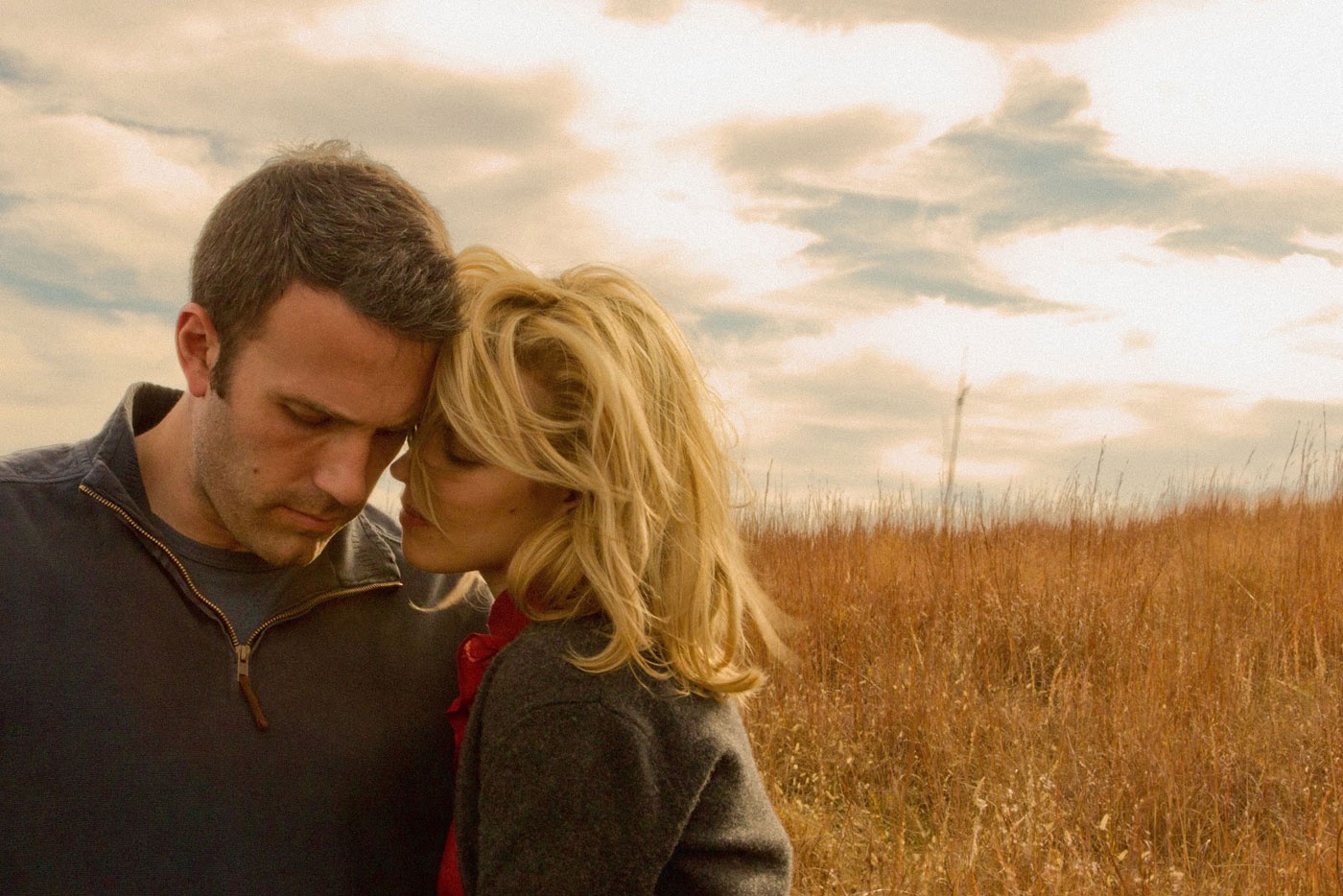
A poetic chronicle of love lost and found and spinning off into some beguiling crepuscular spiritual limbo, To the Wonder is the first film from Terrence Malick set entirely in the contemporary world. Coming less than two years after The Tree of Life, it is also a remarkable addition to Malick’s oeuvre for the swiftness with which it follows its predecessor. Malick bridges the mainstream and the personal in a manner unique in today’s marketplace; he manages to helm the most lavish and star-studded art films in the world. He is one of the cinema’s most stalwart recluses and secret-keepers, a Salingerian sorcerer typically steeped in genesis (and, it would seem, Genesis) for unusually prolonged periods; he is, or was, as famous for the lengthy gaps between his films—two decades and various industrial sea changes passed between the releases of Days of Heaven and The Thin Red Line—as for those films’ unforgettable lyricism, their idiosyncratic voice-overs and hifalutin philosophical preoccupations. That To the Wonder arrives as expediently and with as relatively little fanfare as it does is in a sense a positive development. I like the idea that Malick, now nearing 70, is suddenly opting to try his hand at being a steady working filmmaker, rather than lording over major cinematic events and contending with all the unreasonable expectations that come with that. (How tired I am of hearing people weigh in on The Tree of Life as though it were the dawn of man… Mm, wait a minute…) Point is, I like that Malick might be willing to submit his muse to a more relaxed and less brooded-over process, to offer us more variations on his sui generis way of making films, even at the risk of failure.  


To the Wonder finds Malick taking what has emerged as the modus operandi of the second phase of his career to new extremes. The film is for the most part almost devoid of dialogue. All is montage and a disembodied chorus of voices speaking to their conscience, or their god, or their own existential reckoning. Malick has all but left conventional narrative and character development behind, and this liberation is often thrilling and adventurous. It also comes at a price. Malick, one of the few U.S. filmmakers of the ’70s who has retained the dogged integrity of that heady era, needs name-stars to make his work the way he wants to—i.e.: meticulously designed (by Jack Fisk), gorgeously photographed (by Emmanuel Lubezki), and wildly expensive compared to most films this idiosyncratic—and, though he recently managed to draw from Brad Pitt the finest performance of his career, it isn’t easy to find handsome mainstream actors sensitive to his style and its pitfalls. Enter Ben Affleck, for all his PR problems a perfectly likable persona and an actor of talent—but not so great at transmitting complex emotions with only body language and a downturned jaw at his disposal. He mopes an awful lot in To the Wonder, as the Oklahoman environmental inspector who falls in love with an elfin, mercurial, exotically beautiful Frenchwoman (Olga Kurylenko), and, later, with an American (Rachel McAdams), who seems very down-to-earth, who rides horses and seems as comfortable in his expansive, architecturally dull Midwestern milieu as the Frenchwoman is oppressed by it. In The Tree of Life, The New World and The Thin Red Line, Malick used women as idealized figures of beauty and consolation. In To the Wonder, by contrast, the women seem seem far more developed (and more interestingly embodied), and the male lead feels vaguely drawn. Meanwhile, the landscapes these characters inhabit are reliably evocative, an element that should be regarded as the content of the movie as much the story itself. I should mention that there is also a supplementary narrative thread involving a priest, played by Javier Bardem. Bardem’s passages are superfluous, a little wonky and perfectly in keeping with Malick’s cosmology.


What to do with a film like To the Wonder? It is seriously flawed. It is also crafted with a level of editorial expressionism, an attention to texture and rhythm and awe, that surpasses that of nearly everything else out there. I must be a true believer, because to my estimation any Terrence Malick film, even a seriously flawed one, is still a more wondrous cinematic experience than most. But even if you’re not a believer, even if you’re not easily seduced by this succession of twirling skirts, honey-dipped sunsets, bodies clinging, struggling or wandering, terrains both arid and damp, whispered confessions and visions of splendour, I dare say that, if you’ve ever been plunged into vertigo by love, if you’ve ever taken a chance on a life with someone who defies your set notions of how to live, if you’ve ever wondered how love can be so capricious, how you can feel such overwhelming desire for more than one person, then To the Wonder may captivate you. Okay, parts of it may. This simplest of story’s insights don’t come through exchanges of dialogue or elaborate dramatic turns but, rather, through the suggestive powers of confluence, the way that image and sound and ideas and faces mingle and blur. The film feels like a dance, one that stumbles here and there, like a deluge of emotions and sensations that can be felt acutely in passing but never held onto in any permanent way. So the corny title is also accurate. To the Wonder invites us to surrender to it, to wonder at love’s fleetingness and grandeur, even as it invites us to sniff at its pretensions and unfulfilled ambitions. Which of those two actions would you prefer to take on? 


Monday, April 22, 2013

The inexhaustible poetry of Malick's murder song


They cross paths in a sleepy Texas town. He throws trash, she twirls baton. He’s a figure that seems to have walked out of a dream, or out of the movies, an orphan, without ties; she’s a child still, living with her widower father, waiting to be formed. Dressed in denim and a white tee stretched across his chest, he’s the handsomest man she ever met. He’s also very polite. And what is it that attracts him to her? Her gawky beauty? Her awe? Perhaps it is a matter of pure innocence—though in the end his naïveté seems even greater than hers, sustained by a peculiar solipsism which is unnervingly endearing, is perhaps a distinctly American, and leads to murder and folk-celebrity.


Terrence Malick’s feature debut remains so wondrous and strange—it never releases its mysteries, and it never gets old. Yet Badlands (1973) can also seem straightforward, almost a genre piece, a story of lovers on the run drawn from recent U.S. history: the senseless killing spree undertaken by Charles Starkweather and his captive/lover/possible collaborator Caril Ann Fugate in 1958. Malick’s couple falls far short of the violence and depravity of their models; violence is almost incidental to them, happening outside of their agency, largely bloodless or something that can be set fire to and feel dazzled and warmed by. Both are searching for roles to inhabit. Kit (Martin Sheen) is always acting, playing with some vague idea of the misguided antihero. Hands in his pockets, he declares, “I got some stuff to say. Guess I’m lucky that way.” But how to get anyone other than Holly (Sissy Spacek) to listen? Killing people always draws attention. They start with Holly’s father (a cameo role for the great Warren Oates), before moving elsewhere, living outdoors for a spell, stealing cars, crossing state lines. Kit’s kill-list seems bafflingly random; he’s making it up as he goes along, and preparing his public statements for his inevitable moment of capture. And all the while we hear Holly’s voice, floating dreamlike on the soundtrack, narrating their adventure as though it’s to be read in the pulpy pages of some variant of True Romance with a mildly surrealistic streak: “He wanted to die with me and I wanted to be lost in his arms forever… I spelled out entire sentences on the roof of my mouth where no one could find them.” Both characters focus themselves on speaking to posterity, not living in the moment but rather observing the moment from afar. Maybe that’s what makes it so easy to kill folks.


Immaculately crafted, imbued with music that never emphasizes dread (most notably the Carl Orff piece performed by children), suffused with the sort of images of nature’s glorious indifference that would become part of its director’s signature (see The Thin Red Line [1998] et al), Badlands plays like a propulsive narrative as you watch it but hovers forever in memory as a scrapbook of images and sounds: the wedding cake that spent a decade in the ice-box, the launching of a balloon, the little house on an arid plain filled with a life’s collection of curious useless objects whose meaning is lost with the death of its sole inhabitant. A most welcome addition to the Criterion Collection, Badlands new DVD and Blu-ray edition features a marvelous series of interviews with Malick’s steady production designer Jack Fisk and editor Billy Webber, and with Sheen and Spacek, so extraordinary both, speaking of how Malick saw something in them that no one else did, changed their careers as a result—and changed film history, too. 
          

Wednesday, June 22, 2011

The Tree of Life: Rooted in experience


“Tell us a story from before we can remember.” This request, posed to his mother by one of the O’Brien boys (the one, in fact, whose death years later marks our dramatic entry point into
The Tree of Life), suffuses Terrence Malick’s new work and its elliptical, headlong exploration of memory and meaning. It’s a collage in which narrative causality bends to memory’s errant patterns and the imagination’s serpentine longings. Here we have the young Mr. and Mrs. O’Brien (Brad Pitt and Jessica Chastain) starting a family in Waco, Texas in the 1950s; here we have their eldest son Jack (Sean Penn) as a melancholic businessman in contemporary Houston; here we have Jack as a boy (Hunter McCracken) traipsing through the Waco suburbs with his brothers, drawing comfort from his mother or wishing violence upon his frustrated, disciplinarian father (“Do you love your father?” “Yes, sir.”); here we have fantasies of Mrs. O’Brien defying gravity, encased in a glass coffin like Sleeping Beauty, or mingling on some faraway beach that might resemble heaven, or at least a fleeting notion of one. And here we have interstellar plumes of gas, asteroids silently crashing into planets, light curving into the shape of a flame, and life rising up from the sea. All those things “from before we can remember,” our dreams of prehistory, our invented images of our parents’ childhoods, merge with haunting assemblies of things recalled. Malick’s approach makes no divisions between the present, the past and the deep past, between the living and the dead. You’ll walk away from The Tree of Life recalling the part where Mrs. O’Brien shields her son’s eyes from the man having an epileptic seizure, the part where the kids enjoyed their Halloween parade, or the old man who says, “Good night. We’ll see you in five years.” You’ll feel like there was a whole story somewhere in each of those, and then you’ll go back to see The Tree of Life again and realize that each of those parts was all of about three seconds long. At 67, five films and 40 years into his singular career, Malick has strayed farther from the familiar than ever before, giving us a (semi-autobiographical?) film made of glimpses, reveries, music, and disembodied voices.


It’s those voices, whispered, at times cringingly earnest, that can raise objections, but there’s an irreconcilable tension between voice-over and narrative in Malick’s films going all the way back to
Badlands (1973) that’s worth keeping in mind. From The Thin Red Line (1998) on, Malick has complicated his multi-character voice-overs to the point where it’s sometimes difficult to know who to even attribute them to, including characters who’ve died. There’s a case to be made for The Tree of Life being told entirely from Jack’s perspective, though to make that case you need to accept that Jack’s perspective envelops things “from before we can remember,” even that origin-of-the-universe sequence, made in collaboration with legendary special effects supervisor Douglas Trumbull, and which counters the voice-overs’ creationist overtones with awesome evolutionary imagery (including an exchange between dinosaurs that is for me by far the film’s goofiest risk). The intimate/specific is cast in relief against the infinite/eternal throughout The Tree of Life, so the one-way conversations with god that pervade its soundtrack should be taken as one more source of oppositional elements.


Because so much story and even character development in
The Tree of Life is conveyed through the editing, through Jack Fisk's holistic, transporting production design, and through Emmanuel Lubezki’s energized and lyrical Steadicam work, performance is often a matter of gesture and attitude. Mrs. O’Brien is an idealized, ageless, beatific mother, not unlike Tarkovsky's mother figures, so Chastain is, appropriately, a diaphanous presence. Mr. O’Brien, a source of conflict and lingering resentment for Jack, has more to do, and Pitt, who also co-produced the film, is at his best here, free of the strained mannerisms that plague so many of his other films. But the performance that sticks with me most is McCracken’s, with his wounded eyes, jug ears and quiet confusion, who in some of the most engaging sequences gets into trouble with the neighbourhood kids, torments a poor frog, and enters a stranger’s house to touch foreign things and steal a woman’s slip which he guiltily disposes of in a river. McCracken’s Jack is a branch that extends out to become Penn and, it seems, Malick, our reclusive author, facilitator and dreamer, who’s gone so far out on a limb here and yet is still able to climb down, plant his feet on solid ground and perform the cinema’s oldest, most rewarding trick: transmitting a cosmos of feeling and wonder through a single, sensitive, responsive human face.

Monday, January 14, 2008

There Will Be Blood: Paul Thomas Anderson's geyser of black and sticky dreams


Epic in scale and theme while intimate in cast, Paul Thomas Anderson’s There Will Be Blood, the writer/director’s fifth and finest feature, is something fiery and looming, controlled and eccentric, and fully deserving of the superlatives it continues to attract. Based, rather tenuously, on prolific muckraker Upton Sinclair’s 1927 novel Oil!, the film zeroes in from the start on a single, fascinating figure whom it will monitor for the entirety of its mesmerizing two-and-a-half-hours, one Daniel Plainview, a capitalist of fearsome, tireless ambition and great daring, seeking power for its own sake, setting upon a thrilling trajectory that will inevitably lead back to a hollow center.

Set at the dawn of the 20th century, the shape of the still virginal American frontier in There Will Be Blood is being dictated by pretty much the same forces that will dominate American life at the dawn on the next: oil and religion. Perhaps we should add family into the mix. Rest assured the film’s title foreshadows the spilling of blood, but the place from which it springs is a wounded psyche where genuine blood ties are sorrowfully lacking in this tale of obscurely formed and violently broken families.

The opening scenes are precariously compelling. Plainview, solitary, with everything still ahead of him, is found burrowing deep into the earth, carving the first niche in his tunnel to hell. Ostensibly mining for silver, he strikes black gold. Soon after he’s seen working his first derrick where a fatal injury to a co-labourer makes Plainview the unexpected father to an orphaned infant. Years after that, we encounter Plainview the established oilman, his little boy H.W. beside him in dark suit and parted hair, the quiet, attentive partner in his father’s estimable enterprise.

The extensive sequence that yields these developments sucks us into the tale with raw, muscular physicality, virtually no dialogue, and music provided by Radiohead’s Johnny Greenwood, alternately drawing tension to a single unnerving point or creating an ominous insectile flurry of activity with low strings. Rarely are so many components so much of a piece, the space and texture evoked in the production design by Jack Fisk (Days of Heaven) beautifully lining Anderson’s catalogue of striking images: the exploding geyser that blasts H.W.’s hearing away, the vast puddle of crude that reflects the desert sky, which itself represents the limit of Plainview’s potential wealth. While the barren landscape on display in There Will Be Blood might seem to limit Anderson’s palate, the film never falls short on arresting spectacle.

The dramatic core takes hold with the coming of Paul Sunday, a goat farmer’s son who approaches Plainview one night to announce the discovery of oil on his father’s otherwise worthless hardscrabble. Plainview offers a trifling up front and Paul thence vanishes for the rest of the movie, only to be replaced by his far more imposing twin brother Eli once Plainview arrives on their land under false pretences. Plainview acquires the property for a song, but Eli, whose aspirations are to become a charismatic preacher and founder of The Church of the Third Revelation, has Plainview’s number. A line is drawn in the sand between these opponents, one representing business, the other religion, each eventually needing to align however uneasily with the other.

Both Paul and Eli are played by the terrifically unlikely star Paul Dano, who made a distinct impression as the nihilistic teen in Little Miss Sunshine. He has a girlish manner that props up the considerable rage he generates here as a slight, chinless youth easily underestimated. His Eli is a talented performer, shaking the arthritis from an old lady’s shriveled hands and tossing invisible Satan out on his ass before an admiring rural congregation. He works himself into impressive fits of hysteria, which will pay off intriguingly in the film’s bravura –if somewhat overcooked– finale.

But the film belongs to Daniel Day-Lewis, lording over the proceedings as the brilliant and monstrous Plainview. I can’t come up with another actor who could do quite what Day-Lewis has done here. Larger than life, yet so very tangible a presence, his Plainview has a sparkle of the dreamer in his eye, and a lovingly protected ruthlessness that only fully falls away when he no longer has anyone left to convince, when accident and destiny determine his absolute loneliness. (Among these determining circumstances is the arrival of a mysterious half-brother, marvelously played by Kevin J. O’Connor with the weathered calm of a weary chameleon.)

Perhaps the most impressive aspect of Day-Lewis’ performance lies in his voice, its folksy oratorical nuances marked by an overt homage to the memorable modulations of John Huston. And like Noah Cross, Huston’s wondrously evil cameo in Chinatown, Day-Lewis’ Plainview has tethered himself like some mad proprietor to a natural resource. His hubris writ-large is a symbol of American arrogance, avarice and a sort of appalling beauty, a personality so grand and weirdly inviting, even as it festers the basest of needs. If anyone can sell our earth’s riches to us as though he invented it in his basement workshop, it’s this guy. And for the duration of There Will Be Blood, we are his stunned, happily bamboozled customers.

Thursday, November 22, 2007

Transitions, transfiguration, splendour: Days of Heaven

When writing about the films of Terrence Malick, it’s difficult not to get caught up in reverie, not only because his films possess such a cherished place in the culture—one continually made the subject of heated critical debate—but because reverie itself holds such an axial position in Malick’s films. They are films that, despite their grandeur, evocation of period and high production values, generally shy away from the narrative pay-offs typical of big movies, instead immersing the viewer in an extremely rare experience of sensual immediacy.

Malick’s
Days of Heaven (1978), his second Oscar-winning feature as writer/director, at once cemented his unusual approach to filmmaking and, for a time at least, became his unexpected swan song. (He wouldn’t make a third film until 1998’s The Thin Red Line). Following a trio of migrant farm labourers—the on-the-lam Bill (Richard Gere), his girlfriend Abby (Brooke Adams), who poses as his sister, and his real sister Linda (the extraordinary Linda Manz)—the story settles on an enormous spread of wheat fields overseen by a sickly, shy young farmer (Sam Shepard). The trio works the harvest and finally stays the winter when the farmer confesses his affection for Abby. All this constitutes story, yet what Days of Heaven really deals in is moments, passages, transitions, transfiguration, splendour and the vulnerability of human beings when set against boundless country.

The title’s Biblical allusion is reinforced in numerous compelling ways: Linda’s remarkable, endearingly awkward, heavily accented voice-over, in which she speaks about the Biblical apocalypse while images of smiling travellers under blue skies unfurl; the eventual scenes of fires spreading out of control; the plague of locusts that consume the farmer’s property and are sometimes revealed in close-up with the same attention and awe that Malick bestows upon the characters and objects. Edited to accentuate the film’s poetic sensibility, images shift continually between small details outlining the characters’ emotional stakes and the world with which they’re forced to negotiate.

Though set during the second decade of the 20th century,
Days of Heaven carries with it something of the ghost of the 19th, particularly in its undercurrents of philosophy gleaned from Emerson and Thoreau, and in its evocation of man’s uneasy status in a still-new age of machinery, enterprise and expansion. A love triangle gives the film its narrative centre, but another triangle is just as prominent in its thematic core, one drawn between man, nature and industry. The heavenly days are fleeting indeed, their vestiges cradled in the embrace of Malick’s sumptuous camerawork, as fleeting as the harvest season’s magic hour that sweeps across the prairies in so many of the film’s most achingly beautiful scenes.

It’s not only because of it’s key creative talents—Malick, cinematographers Nestor Almendros and Haskell Wexler, composer Ennio Morricone and the lead actors—that
Days of Heaven is such a special film. Shot in the seemingly endless, roadless, Hutterite lands of Southern Alberta with a luxurious shooting schedule, an exceedingly loose observance of union restrictions and granted considerable freedom under the auspices of Paramount, it’s a film that could probably only have been made in that particular window of history, before the demise of director-driven projects, the exploitation of the land and the micromanaged system of filmmaking took hold.

The singularity of the elements feeding into
Days of Heaven is something made clear time and again on Criterion’s new DVD, which in my book is probably the single-best single-disc package of the year. The ever-reclusive Malick is unsurprisingly not a collaborator in the film’s extras, but this in no way detracts from their appeal and information. In fact, there are times when great directors make the weakest commentators, as they’re unable to articulate their feelings about work that’s emerged from such a slippery, instinctive part of the creative consciousness. This might go some way to explaining why the audio commentary on Days is so good. Performed by the film’s editor, casting director, production designer and costume designer, the commentary is so rich with anecdote and laid-back analysis precisely because these comparatively peripheral collaborators were simultaneously heavily involved in multiple aspects of the film and able to stand back and see it from a distance. And they reveal countless fascinating tidbits of production history, like how John Travolta and Tommy Lee Jones were originally considered for the roles of Bill and the farmer, how Manz was found living in a laundromat in Manhattan, how Hutterite kids built the row houses for $5 an hour or how the clouds of locusts were created by dropping seeds from the sky and shooting them in reverse.

Of equal interest is a long, thoughtful interview with camera operator (and later cinematographer) John Bailey and a shorter, less articulate, but still fun interview with Wexler. There are also great interviews with Gere and Shepard that deal with their complex interpretations of Malick’s vision and his elusive and sometimes frustrating method of working with actors, not to mention with their own off-camera crushes on Adams. Last but not least there’s a wonderful extract from Almendros’s autobiography that talks in largely layman’s terms about the daring experiments with natural light that endowed the film with its haunting imagery, and an excellent essay by Adrian Martin.