
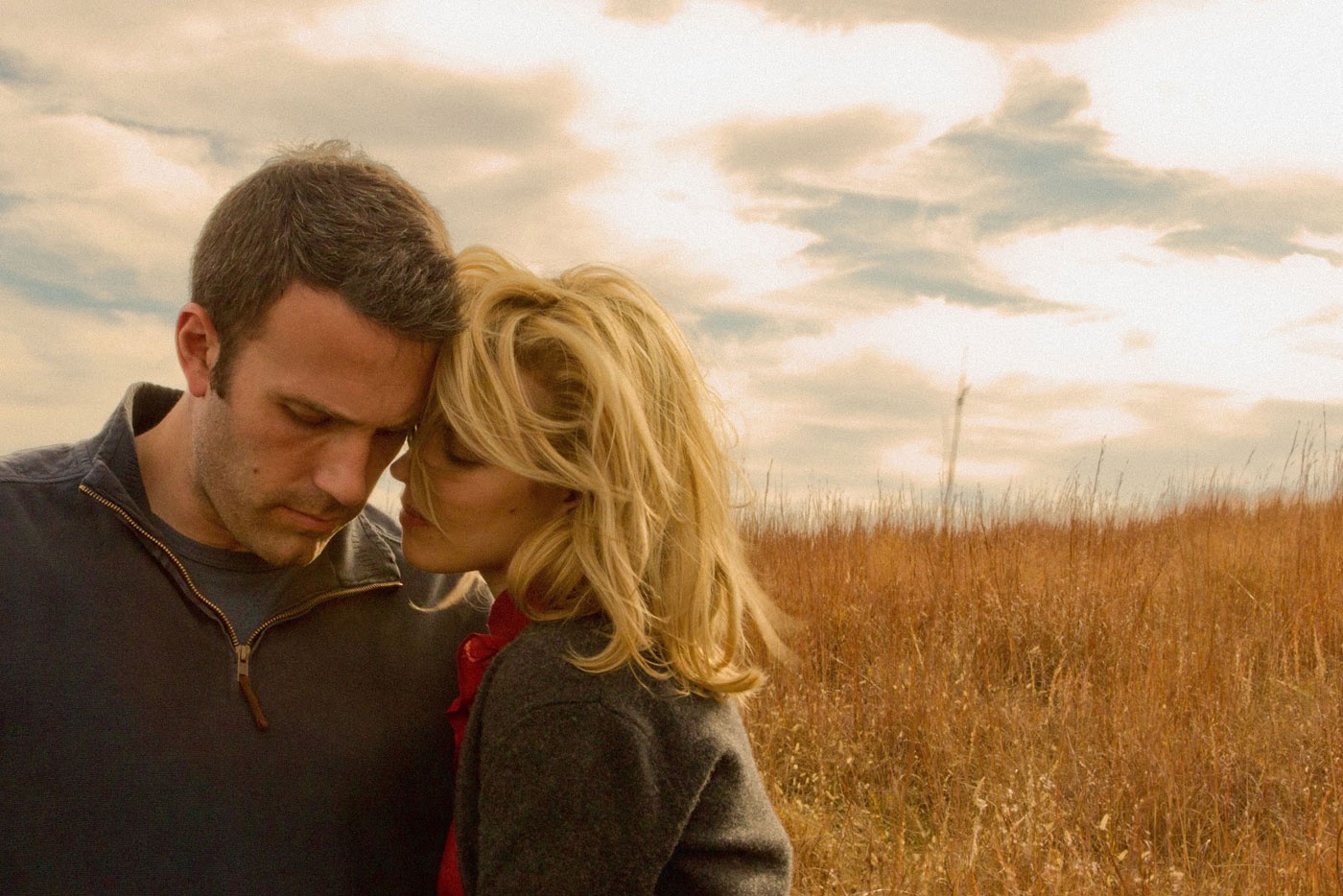
A poetic
chronicle of love lost and found and spinning off into some beguiling
crepuscular spiritual limbo, To the
Wonder is the first film from Terrence Malick set entirely in the
contemporary world. Coming less than two years after The Tree of Life, it is also a remarkable addition to Malick’s
oeuvre for the swiftness with which it follows its predecessor. Malick bridges
the mainstream and the personal in a manner unique in today’s marketplace; he
manages to helm the most lavish and star-studded art films in the world. He is
one of the cinema’s most stalwart recluses and secret-keepers, a Salingerian
sorcerer typically steeped in genesis (and, it would seem, Genesis) for unusually prolonged periods; he is, or was, as famous
for the lengthy gaps between his films—two decades and various industrial sea
changes passed between the releases of Days
of Heaven and The Thin Red Line—as
for those films’ unforgettable lyricism, their idiosyncratic voice-overs and hifalutin
philosophical preoccupations. That To the
Wonder arrives as expediently and with as relatively little fanfare as it
does is in a sense a positive development. I like the idea that Malick, now
nearing 70, is suddenly opting to try his hand at being a steady working filmmaker,
rather than lording over major cinematic events and contending with all the unreasonable
expectations that come with that. (How tired I am of hearing people weigh in on
The Tree of Life as though it were
the dawn of man… Mm, wait a minute…) Point is, I like that Malick might be
willing to submit his muse to a more relaxed and less brooded-over process, to
offer us more variations on his sui generis way of making films, even at the
risk of failure.

To
the Wonder finds Malick taking what has emerged as the modus operandi of
the second phase of his career to new extremes. The film is for the most part
almost devoid of dialogue. All is montage and a disembodied chorus of voices
speaking to their conscience, or their god, or their own existential reckoning.
Malick has all but left conventional narrative and character development
behind, and this liberation is often thrilling and adventurous. It also comes
at a price. Malick, one of the few U.S. filmmakers of the ’70s who has retained
the dogged integrity of that heady era, needs name-stars to make his work the
way he wants to—i.e.: meticulously designed (by Jack Fisk), gorgeously
photographed (by Emmanuel Lubezki), and wildly expensive compared to most films
this idiosyncratic—and, though he recently managed to draw from Brad Pitt the
finest performance of his career, it isn’t easy to find handsome mainstream
actors sensitive to his style and its pitfalls. Enter Ben Affleck, for all his PR
problems a perfectly likable persona and an actor of talent—but not so great at
transmitting complex emotions with only body language and a downturned jaw at
his disposal. He mopes an awful lot in To
the Wonder, as the Oklahoman environmental inspector who falls in love with
an elfin, mercurial, exotically beautiful Frenchwoman (Olga Kurylenko), and,
later, with an American (Rachel McAdams), who seems very down-to-earth, who
rides horses and seems as comfortable in his expansive, architecturally dull
Midwestern milieu as the Frenchwoman is oppressed by it. In The Tree of Life, The New World and The Thin
Red Line, Malick used women as idealized figures of beauty and consolation.
In To the Wonder, by contrast, the women seem seem far more developed (and more
interestingly embodied), and the male lead feels vaguely drawn. Meanwhile, the
landscapes these characters inhabit are reliably evocative, an element that
should be regarded as the content of the movie as much the story itself. I
should mention that there is also a supplementary narrative thread involving a
priest, played by Javier Bardem. Bardem’s passages are superfluous, a little
wonky and perfectly in keeping with Malick’s cosmology.

What to do with a film like To the Wonder? It is seriously flawed. It is also crafted with a
level of editorial expressionism, an attention to texture and rhythm and awe, that
surpasses that of nearly everything else out there. I must be a true believer,
because to my estimation any Terrence Malick film, even a seriously flawed one,
is still a more wondrous cinematic experience than most. But even if you’re not
a believer, even if you’re not easily seduced by this succession of twirling
skirts, honey-dipped sunsets, bodies clinging, struggling or wandering, terrains
both arid and damp, whispered confessions and visions of splendour, I dare say
that, if you’ve ever been plunged into vertigo by love, if you’ve ever taken a
chance on a life with someone who defies your set notions of how to live, if
you’ve ever wondered how love can be so capricious, how you can feel such
overwhelming desire for more than one person, then To the Wonder may captivate you. Okay, parts of it may. This
simplest of story’s insights don’t come through exchanges of dialogue or
elaborate dramatic turns but, rather, through the suggestive powers of confluence,
the way that image and sound and ideas and faces mingle and blur. The film
feels like a dance, one that stumbles here and there, like a deluge of emotions
and sensations that can be felt acutely in passing but never held onto in any
permanent way. So the corny title is also accurate. To the Wonder invites us to surrender to it, to wonder at love’s
fleetingness and grandeur, even as it invites us to sniff at its pretensions
and unfulfilled ambitions. Which of those two actions would you prefer to take on?


