Showing posts with label The Tree of Life. Show all posts

Monday, May 20, 2013

Love streams, ebbs, branches off elsewhere


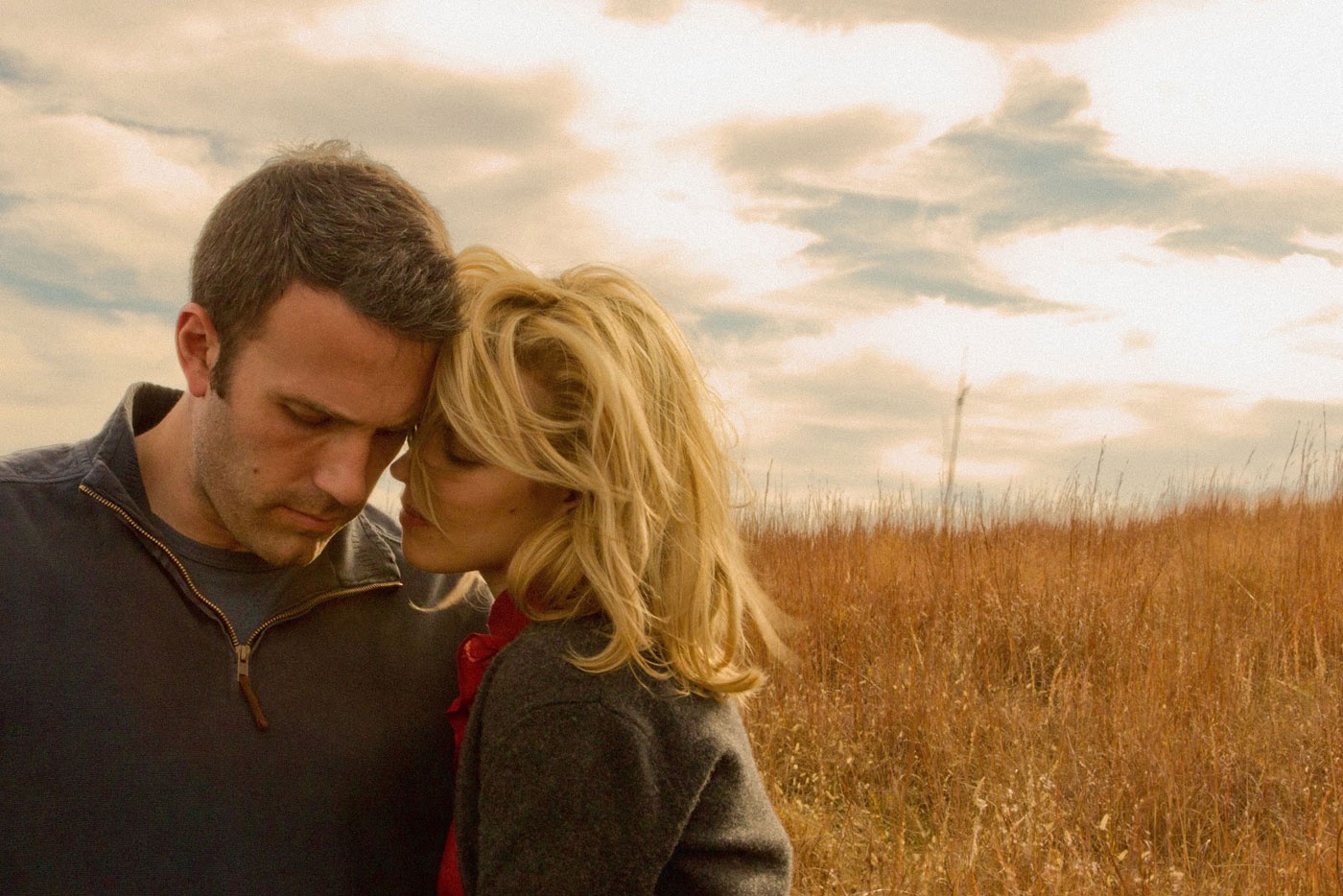
A poetic chronicle of love lost and found and spinning off into some beguiling crepuscular spiritual limbo, To the Wonder is the first film from Terrence Malick set entirely in the contemporary world. Coming less than two years after The Tree of Life, it is also a remarkable addition to Malick’s oeuvre for the swiftness with which it follows its predecessor. Malick bridges the mainstream and the personal in a manner unique in today’s marketplace; he manages to helm the most lavish and star-studded art films in the world. He is one of the cinema’s most stalwart recluses and secret-keepers, a Salingerian sorcerer typically steeped in genesis (and, it would seem, Genesis) for unusually prolonged periods; he is, or was, as famous for the lengthy gaps between his films—two decades and various industrial sea changes passed between the releases of Days of Heaven and The Thin Red Line—as for those films’ unforgettable lyricism, their idiosyncratic voice-overs and hifalutin philosophical preoccupations. That To the Wonder arrives as expediently and with as relatively little fanfare as it does is in a sense a positive development. I like the idea that Malick, now nearing 70, is suddenly opting to try his hand at being a steady working filmmaker, rather than lording over major cinematic events and contending with all the unreasonable expectations that come with that. (How tired I am of hearing people weigh in on The Tree of Life as though it were the dawn of man… Mm, wait a minute…) Point is, I like that Malick might be willing to submit his muse to a more relaxed and less brooded-over process, to offer us more variations on his sui generis way of making films, even at the risk of failure.  


To the Wonder finds Malick taking what has emerged as the modus operandi of the second phase of his career to new extremes. The film is for the most part almost devoid of dialogue. All is montage and a disembodied chorus of voices speaking to their conscience, or their god, or their own existential reckoning. Malick has all but left conventional narrative and character development behind, and this liberation is often thrilling and adventurous. It also comes at a price. Malick, one of the few U.S. filmmakers of the ’70s who has retained the dogged integrity of that heady era, needs name-stars to make his work the way he wants to—i.e.: meticulously designed (by Jack Fisk), gorgeously photographed (by Emmanuel Lubezki), and wildly expensive compared to most films this idiosyncratic—and, though he recently managed to draw from Brad Pitt the finest performance of his career, it isn’t easy to find handsome mainstream actors sensitive to his style and its pitfalls. Enter Ben Affleck, for all his PR problems a perfectly likable persona and an actor of talent—but not so great at transmitting complex emotions with only body language and a downturned jaw at his disposal. He mopes an awful lot in To the Wonder, as the Oklahoman environmental inspector who falls in love with an elfin, mercurial, exotically beautiful Frenchwoman (Olga Kurylenko), and, later, with an American (Rachel McAdams), who seems very down-to-earth, who rides horses and seems as comfortable in his expansive, architecturally dull Midwestern milieu as the Frenchwoman is oppressed by it. In The Tree of Life, The New World and The Thin Red Line, Malick used women as idealized figures of beauty and consolation. In To the Wonder, by contrast, the women seem seem far more developed (and more interestingly embodied), and the male lead feels vaguely drawn. Meanwhile, the landscapes these characters inhabit are reliably evocative, an element that should be regarded as the content of the movie as much the story itself. I should mention that there is also a supplementary narrative thread involving a priest, played by Javier Bardem. Bardem’s passages are superfluous, a little wonky and perfectly in keeping with Malick’s cosmology.


What to do with a film like To the Wonder? It is seriously flawed. It is also crafted with a level of editorial expressionism, an attention to texture and rhythm and awe, that surpasses that of nearly everything else out there. I must be a true believer, because to my estimation any Terrence Malick film, even a seriously flawed one, is still a more wondrous cinematic experience than most. But even if you’re not a believer, even if you’re not easily seduced by this succession of twirling skirts, honey-dipped sunsets, bodies clinging, struggling or wandering, terrains both arid and damp, whispered confessions and visions of splendour, I dare say that, if you’ve ever been plunged into vertigo by love, if you’ve ever taken a chance on a life with someone who defies your set notions of how to live, if you’ve ever wondered how love can be so capricious, how you can feel such overwhelming desire for more than one person, then To the Wonder may captivate you. Okay, parts of it may. This simplest of story’s insights don’t come through exchanges of dialogue or elaborate dramatic turns but, rather, through the suggestive powers of confluence, the way that image and sound and ideas and faces mingle and blur. The film feels like a dance, one that stumbles here and there, like a deluge of emotions and sensations that can be felt acutely in passing but never held onto in any permanent way. So the corny title is also accurate. To the Wonder invites us to surrender to it, to wonder at love’s fleetingness and grandeur, even as it invites us to sniff at its pretensions and unfulfilled ambitions. Which of those two actions would you prefer to take on? 


Wednesday, March 28, 2012

"...if you can touch the skin you can touch the spiritual...": Tran Anh Hung on Norwegian Wood


A story of sexual discovery, devastating loss, self-realization and all kinds of love in various geometries, set amidst the political unrest of Tokyo university life in the late 1960s, Norwegian Wood is the fifth feature from Tran Anh Hung, who’s works include The Scent of Green Papaya and The Vertical Ray of the Sun. Tran’s films possess a sensual languor, a vivid fecundity, a certain tenderness and grace that, despite the fact that he was born in Vietnam, lives in France, and doesn’t speak Japanese, made Tran an ideal filmmaker to adapt Haruki Murakami’s beloved 1987 heartbreaker-breakthrough, the author’s sole novel that contains no elements of the fantastical, in which the shy yet charismatic Toru Watanabe wrestles with irrepressible youthful desires, ambiguous relationships, an innate resistance to the youth movements enveloping him, and the suicides of more than one of his closest friends.


The lead performances by Kenichi Matsuyama, Kiko Mizuhara and Rinko Kikuchi, who most of you will probably recognize from her Oscar-nominated turn in Babel, balance varied degrees of physical or social awkwardness with glimpses of inner turmoil and sudden sparks of preternatural wisdom. The photography by Mark Lee Ping Bin, best-known for his collaborations with Hou Hsiao-hsien and Wong Kar-wai, would seem almost too sublimely pretty if it weren’t so utterly precise, governed by the dictates of narrative and close attention to the actor’s impulses. The music by Radiohead’s Johnny Greenwood, who previously scored There Will Be Blood, seems born of a bubbling caldron of romantic-modernist strife. And the sweaters are to die for. (Costume credit goes to Tran Nu Yên-Khê, the writer/director’s wife and frequent star.)

I think we cover a fair amount of ground in the conversation transcribed below, so I’ll refrain from whipping up much in the way of analysis here. I spoke with Tran while he was visiting Toronto last October.

Tran Anh Hung during production on Norwegian Wood

JB: Norwegian Wood is arguably Murakami’s most overtly personal work. Certain elements seem almost autobiographical. Do you feel any kind of similarly personal connection?

Tran: Yes, but only because of the broad themes. Someone finds first love and then loses it, someone is first confronted with grief, or first has to accept the consequences of major life decisions—all this is universal. On a certain level it could have happened to anyone. I think the international success of the book comes from this.

JB: But there’s also this specific theme of suicide and its effect on those left in its wake, the suggestion that when you encounter suicide at a young age it throws a shadow over everything in your life from that point on. All of the choices Watanabe makes after coming into contact with suicide seem influenced by that contact.

Tran: This is true, but we have to recognize that suicide is also a narrative mechanism. The suicide of Kizumi at the beginning of the movie is traumatic for Naoko, and the mechanism starts to work on her when she has sex with Watanabe. Suddenly she doesn’t understand why she couldn’t make it with Kizuki yet now she can make it with a boy she doesn’t love. This mechanism is at work throughout the story. Life is just experience. You can only harness the beauty of experience through art. As an artist you have to find out how to express experience so that the audience can draw the beauty from it. You want the audience to leave the theatre carrying some trace of that beauty with them.

JB: Norwegian Wood closes on quite a bracing note, just the black screen and those final words spoken about how Watanabe’s friends will be 17 and 21 forever, while he has to continue to grow older.

Tran: Yes, I’m quite proud of that. [Laughs] Those words exist somewhere in the book, but to pluck them out and place them at the end feels very right, better than anything I would have created by myself.


JB: I imagine Norwegian Wood demanded a very different development process for you. Your preceding films are rather spare in incident and you give a lot of room for scenes to breathe; with Norwegian Wood you have a great deal of plot to manage. Did you find that process enjoyable? Or was it frustrating?

Tran: Everything that is difficult in the creative process is enjoyable. I like having problems to solve. When you move from one form to another, you have to build emotion from the devices specific to the new form. For example, you have this sequence where you see Watanabe mourning by the sea, then in the next scene he’s making love with a woman, then in the next scene he calls another woman and says, “I love you.” It’s disturbing. Normally such behavior is not acceptable. But when you’ve surrendered to this story it seems acceptable. My challenge is to make an audience intuit this without fully understanding exactly what happened. When Reiko asks Watanabe to make love to her, it’s a rescue scene. Meaning that by making love to her he would give back to her what she has lost—her sexuality. By saving her he feels his guilt towards Naoko lighten. Which means he can reclaim his life and tell Midori that he loves her.

JB: The book has a framing device: a man—the narrator—sits on a plane, hears some music, and is drawn into the past. So it’s all channeled through memory. In the movie that framing device survives only through a very sparing use of voice-over. Did you ever think of structuring the movie similarly, as a memory collage?

Tran: No. Structures relying on flashbacks feel too mechanical. I don’t really like them. But there’s a more important reason. Normally when you move back and forth between present and past you need to show how the past changed or influenced the present somehow. In the book there’s nothing like that. It’s just a voice. So for me to follow this structure I would need to create other events happening in the present. I prefer to focus on the past. To show the wound when it’s fresh. Using a little voice-over was just a way of bringing the melancholy out of the story.

JB: I guess if you tried to weave in the present then you’d be stuck shooting a lot of coverage of some guy on an airplane, thinking.

Tran: [Laughs] Yes. Airplane, then hotel room... Not really interesting.


JB: Murakami’s characters tend to be very composed, at least externally. Your rendering of Norwegian Wood features at least two elements that seem to counter that. One is your allowance of Naoko to succumb to these tempests of convulsive weeping. The other is Johnny Greenwood’s music, which expresses a lot of high emotion.

Tran: Murakami’s characters are always meant to be normal people. Given the romantic nature of this story he could have created moments where the characters go really crazy, do spectacular things. But he always stays with normal people. That’s a great strength. Everyone can identify with his characters. So I had to maintain that aspect while at the same time give voice to the romantic side of things. Johnny Greenwood has a special talent for creating very serious, very dark music that has this captivating beauty. I don’t like the idea of creating so many variations in music. I wanted it to speak to the deep, dark parts of the characters.

JB: I like that you say that, because the movie strikes me as having a very bold sort of sonic division. The diegetic sound serves one purpose, the popular music serves one purpose, and the score serves one purpose.

Tran: Yes. I’m happy about that.


JB: I was also very drawn to your use of landscape, the specificity brought to looking at the geography of living spaces, the fact that the camera, in my memory at least, seems to be moving almost constantly. There’s the sense that these characters and their intimate story are always set within a larger, very particular landscape.

Tran: I think this is very important. You need to have the physical feeling of a movie. Watanabe’s life is suspended, floating, so you need to find a way to shoot every scene to create a sense of that instability. Every set that we built, every space that we used needed to allow us to move a certain way. Every landscape needed to give wings, somehow, to the emotions of the characters. To be lyrical. That mourning sequence by the sea, for instance. Because what Watanabe is feeling is very primitive, something inside all of us, something that was probably inside the first man on Earth, I needed to find a place that resembled the beginning of life. Only rocks and the violence of the water and the wind. It’s all very essential. All this violence needs to be forceful enough to break through Watanabe’s reserve, to let loose the tears. You cannot explain this to the audience—they just need to feel it. And they way we did this, with this combination of elements, is something that you can do only with movies. When I wake up in the morning it’s precisely this kind of challenging that I’m seeking, that I’m looking forward to as a filmmaker.

JB: Are you familiar with the work of Hiroshi Sugimoto?

Tran: No.


Mediterranean Sea, Hiroshi Sugimoto

JB: Because he has this very famous series of photographs of the sea that have been gleaned from all over the world but in each case the composition is identical.

Tran: Ah, yes! Now that you describe it, of course.

JB: His whole rationale behind that series is very similar to what you were saying about finding a landscape that erases all traces of history, that reflects an idea of landscape—or rather seascape—that exists in some primordial part of the brain.

Tran: Yes, I’ve seen some of these. They are very beautiful.


JB: I want to ask you a little more about camera movement, because it seems like no matter how much activity is transpiring within a scene—I’m thinking specifically about the bit where Watanabe moves through the university campus, with demonstrators passing by—the camera seems to give this feeling of isolation and loneliness to Watanabe that I don’t think we would have found if the camera remained fixed. I don’t know if your approach to camera movement or mise en scène has any sort of overriding philosophy behind it…

Tran: No. It’s only about emotions. The camera in this movie needs to give you the feeling that things are unsettled. You cannot seize the moment easily. Yet, though you may not remember it, there are a lot of scenes where the camera is still… Well, still but not really. [Laughs] Okay, it’s usually moving a little bit.


JB: Something distinctive about your films, something that’s become increasingly precious as we interact more and more with digital media, is their emphasis on sensuality. In the weather, the objects, the way you frame hands and faces and bodies, there’s this sense that we’re being asked to really feel what it’s like to touch things.

Tran: Yes. My idea is that you cannot touch the spiritual directly, but if you can touch the skin you can touch the spiritual, so let’s give the skin to the audience. Everything I’m dong with costumes, lights, locations, everything needs to be there to make the skin more palpable. I don’t need everything to be natural, but I don’t like it when it’s purely symbolic either. Like in The Tree of Life, when you see movement that’s too symbolic I don’t like it. But the movies need to be sensual. People need to feel things. Rain, wind, other people, everything that makes contact with the skin is very important. Paradoxically, I use digital cameras to capture the right feeling of skin. Celluloid has these grains in it, and somehow it puts a layer on top of the skin. With digital cameras you don’t have that anymore. So now I’m shooting all my movies with digital cameras. I don’t want that layer. I want always to touch.

Saturday, December 31, 2011

2011: the year in movies


How do we make sense of the past? What paths does memory take en route to truth, trauma or transcendence? What patterns emerge? Many of my favourite films of 2011, listed below in no particular order (though the first is first for a reason), respond to this question by contrasting the unfathomably vast with the infinitesimal, deep history with willful amnesia, the beginning and end of everything with the harrowing loss of a single life. (Or a single mind.)


Nostalgia for the Light
The central location of Patricio Guzmán’s essay film is Chile’s Atacama Desert, the most arid region on Earth, home to two of the world’s most powerful telescopes, a place where mothers and widows of the disappeared scour the desert floor for trace remains of loved ones while astronomers search the outer reaches of the universe for ancient signs of life. Like many of Guzmán’s earlier films (The Battle of Chile, Salvador Allende), the film interrogates his home country’s selective erasure of unresolved past horrors while waxing nostalgic about its old collective fascination with the wonders of the night sky. Nostalgia For the Light is eloquent, inventive, rigorous, tender, curious and immensely humane.


The Tree of Life
Wildly ambitious (and thus, appropriately, divisive and awkward), Terrence Malick’s latest (a perfect compliment to Guzmán’s—and a perfect corrective to the largely superficial but similarly personal-versus-total-apocalypse narrative of Melancholia) pushes his large canvas/whispered epiphany aesthetic into ever more rippling, impression-flecked terrain, juxtaposing scattered moments of revelation, joy and pain from the childhoods of three Texan boys with nothing less than the origins of life on Earth. The imagery is breathtaking, its arrangement inspired, dictated by its own internal psychic rhythms. The final, mystical sequence is somewhat dubious, but I wouldn’t excise a second of The Tree of Life if it meant dismantling any crucial element in this rare marriage of the spectacular with the personal.


Take Shelter
On that note, Jeff Nichol’s follow-up to Shotgun Stories, his impressive debut, follows the mental collapse of an Ohio labourer and family man (embodied with singular, shambling unease by Michael Shannon) whose knowledge of his possible schizophrenia has him no less convinced that he may be a prophet of the End Times. Set against a all-too recognizable contemporary landscape of economic worries and catastrophic weather, Take Shelter at once speaks broadly to our moment and remains a character study. Like Tree of Life it takes risks and as a result features a problematic finale; like Tree of Life it features a truly remarkable supporting performance from Jessica Chastain in a very difficult matriarchal role.


White Material, Of Gods and Men
Claire Denis’ return to Cameroon finds the formidable Isabelle Huppert refusing to abandon her coffee plantation despite the escalation of a surrounding civil war. Xavier Beauvois’ latest, based on real events, chronicles the final days of a group of Trappist monks who resolve to remain in Algeria during the outbreak of its 1996 civil war. Both films convey a sophisticated sense of the foggy ethics of post-colonial relations and of one’s sense of belonging somewhere; both use music (courtesy of Tindersticks and chanting actors, respectively) to achieve sublime moments of lyricism. White Material is insightful, savage and sinisterly seductive, though one might argue that it, like several other titles on this list, features a clumsy ending, which transitions rather abruptly into the mythic, dragging its heroine along with it.


Le Havre
The intermingling of Europeans and Africans is also very much at the heart of Aki Kaurismäki’s most recent deadpan delight, which, set in the titular French port city, finds an aging shoeshiner helping an African boy with no documents find a safe place to rest and safe passage to London, where he hopes to be reunited with family members that are in an only marginally more secure social position. Le Harve is beautifully—and, typically, idiosyncratically—crafted, with great narrative economy, dry wit, masterful compositions and numerous affectionate homages to French cinema to balance its dour diagnosis of French xenophobia.


Meek’s Cutoff
The fear of the Other is also key to Kelly Reichardt’s most recent work, by far her most industrious yet. It’s a western, albeit one with iconoclastic attention to the everyday chores and struggles of homesteaders lost in 1860s Oregon. The film’s handful of desperate families are led astray by a charismatic frontiersman and are ultimately confronted with the possibility that the dreaded Indian captive they’re traveling with (the magnificently stoic Ron Rondeaux) may be their sole hope for survival. Understated, blending classicism with quietude, and featuring yet another engrossing slow-burn of a performance from Michelle Williams, Meek’s Cutoff ensures Reichardt’s place within the finest American filmmakers of cinema’s second century. Will she continue to branch out into a grander scale of production or retreat into the familiar small? I look forward to whatever she does, either way.


Certified Copy
Another filmmaker in transition: Abbas Kiarostami strays from his native Iran to make a film with a French star (Juliette Binoche, brilliant) and an English opera singer in Italy; the result is very much a Kiarostami film, riddled with a utterly compelling balance of ambiguity and complex emotional/philosophical truths—which says a lot about what we may have reduced to being an exclusively Iranian, Middle Eastern or Third World approach to cinematic storytelling. An author on tour in Tuscany takes a drive with an antique store owner. They discuss the notion of how we place value on the real thing versus the fake, or originals versus copies, of how we invest things with authenticity, and soon we’re unsure about the reality of the relationship we’re watching develop. Did they just meet, or are they in fact an estranged couple? All that matters is the immense resonance of their ongoing questions, grievances and longings, a dialogue with echoes of both Last Year at Marienbad and Before Sunset.


Margaret
While Certified Copy mines a marriage for questions of how to make sense of the messy lives of its disparate halves, Kenneth Lonergan’s legally troubled, long-gestating and long-awaited (yet appallingly neglected) follow-up to the beloved You Can Count On Me examines the awakening of a young woman’s sense of existential responsibility. A horrific accident following an essentially innocent exchange of glances between Anna Paquin’s college student and Mark Ruffalo’s MTA bus driver prompts a complicated series of events involving familial dysfunction, litigation, mourning and arduous self-realization. Intricate and novel-like, Margaret is a film which would probably appear on more Best Of lists if more people (critics included) had actually seen it. It’s a meal of a movie, and deserves far more attention.


Cave of Forgotten Dreams, Into the Abyss
This pair of documentaries from the one and only Werner Herzog touch on numerous themes running through this list, most especially the modern as viewed against the ancient-mysterious and the balancing of crime with punishment in a violent world lacking moral guidance. Cave of Forgotten Dreams takes us into France’s Chauvet Cave and offers glimpses of the artistic soul already alive and well in Stone Age man; Into the Abyss ushers us into the US penal system to examine the lives of incarcerated young men whose abysmally meaningless crimes of murder are met with cold-blooded state-sanctioned murder. In both of these films Herzog’s focus remains firmly on people—souls, if you will—who provide us with illuminating, strange and diverse testaments to the irrepressible drive to survive, create and look ever-forward. Not a bad way to finish off a tumultuous year.

Monday, November 14, 2011

Melancholia: bad vibes all over


Birds tumble softly from the ether; a woman gazes at her hands as they give off sparks; a horse collapses to the ground like an old barn; a woman clutching a child sinks deeper into a darkened golf course; a bride sinks into the surface of a stream or trudges through forest only to be snared by roots. All of this unfolds in extremely slow slow-motion, as though some collective will is urging time to a standstill. And you can see why. The end is nigh. Mind you, it’ll take a while to actually get there.


Had I, for whatever reason, had to exit the theatre after the prologue of Melancholia, an astonishing, kind of devastating sequence heavily indebted to more masters of contemporary photo-based art than you could squueze into a year at ICP, set to the romantic bombast of Wagner’s Tristan and Isolde, I would surely have thought I’d seen the first ten minutes of some rapturous masterpiece. But I stayed, or rather stuck it out, and remembered I was in Lars Land, a place where flights of genius are undermined by lengthy digressions imbued with didacticism, smugness, cynicism and sadomasochistic projections of the author’s disorders onto the opposite sex.


Lars von Trier: maker of some unforgettable images, brilliant conceptualist, shit storyteller. I think I’ve done the image bit, so let’s get to Lars the conceptualist. Melancholia has two parts, two sisters, two disasters. Justine (Kirsten Dunst) shows up two hours later for her insanely lavish wedding reception at a castle. Once she arrives things just get worse: mom (Charlotte Rampling) delivers the most withering wedding speech in history before locking herself in the bathroom and Justine slips ever deeper into debilitating depression. She can barely make it through the night, though disappearing for long spells, telling off her boss and jumping some nervous stranger’s bones seems to help. By dawn, the damage is unrepairable, the marriage still-born. The groom ultimately leaves without her.


After the wedding Claire (Charlotte Rampling) determines to take care of Justine, who’s now verging on catatonic—there’s a painful scene where Claire simply can’t get Justine to step into a hot bath... and that bath looks pretty nice! Claire becomes increasingly preoccupied with the news that a planet called Melancholia has been hiding behind the sun and now seems to be on a collision course with Earth. As apocalypse looms, Claire, quite understandably, becomes hysterical, while Claire's husband (Kiefer Sutherland) turns out to be of no help and Justine is increasingly becalmed and not nice to her at all.


As I summarize all this I realize how much I admire the raw ideas behind Melancholia, the balance of it, that juxtaposition of the individual crisis with the infinite that makes it the nihilist cousin to The Tree of Life. As I think through my experience of Melancholia I have to admit that it was definitely made by someone who really, really gets depression. The problems all come in the way we meander through the story without pace or punctuation, the way we’re meant to bask in the ostensibly clever portraits of one-dimensional or only semi-coherent characters who are mostly just assholes. Everyone, generally, is cruel, though the men tend to be weaklings while the women at least have a certain integrity—and, as with so much von Trier (see Breaking the Waves, Dancer in the Dark, et cetera), that integrity is what ensures their doom. So we watch and we wait for von Trier to do whatever it takes to twist his plots into awkward, sometimes plain stupid knots so as to completely screw over his heroine (though Dogville, it must be said, attempted to reverse this somewhat by allowing its heroine a climatic revenge). We worry, we do indeed feel the burgeoning unease, something von Trier is indeed highly skilled at inducing, and we wait. And the waiting can be tedious.

Wednesday, June 22, 2011

The Tree of Life: Rooted in experience


“Tell us a story from before we can remember.” This request, posed to his mother by one of the O’Brien boys (the one, in fact, whose death years later marks our dramatic entry point into
The Tree of Life), suffuses Terrence Malick’s new work and its elliptical, headlong exploration of memory and meaning. It’s a collage in which narrative causality bends to memory’s errant patterns and the imagination’s serpentine longings. Here we have the young Mr. and Mrs. O’Brien (Brad Pitt and Jessica Chastain) starting a family in Waco, Texas in the 1950s; here we have their eldest son Jack (Sean Penn) as a melancholic businessman in contemporary Houston; here we have Jack as a boy (Hunter McCracken) traipsing through the Waco suburbs with his brothers, drawing comfort from his mother or wishing violence upon his frustrated, disciplinarian father (“Do you love your father?” “Yes, sir.”); here we have fantasies of Mrs. O’Brien defying gravity, encased in a glass coffin like Sleeping Beauty, or mingling on some faraway beach that might resemble heaven, or at least a fleeting notion of one. And here we have interstellar plumes of gas, asteroids silently crashing into planets, light curving into the shape of a flame, and life rising up from the sea. All those things “from before we can remember,” our dreams of prehistory, our invented images of our parents’ childhoods, merge with haunting assemblies of things recalled. Malick’s approach makes no divisions between the present, the past and the deep past, between the living and the dead. You’ll walk away from The Tree of Life recalling the part where Mrs. O’Brien shields her son’s eyes from the man having an epileptic seizure, the part where the kids enjoyed their Halloween parade, or the old man who says, “Good night. We’ll see you in five years.” You’ll feel like there was a whole story somewhere in each of those, and then you’ll go back to see The Tree of Life again and realize that each of those parts was all of about three seconds long. At 67, five films and 40 years into his singular career, Malick has strayed farther from the familiar than ever before, giving us a (semi-autobiographical?) film made of glimpses, reveries, music, and disembodied voices.


It’s those voices, whispered, at times cringingly earnest, that can raise objections, but there’s an irreconcilable tension between voice-over and narrative in Malick’s films going all the way back to
Badlands (1973) that’s worth keeping in mind. From The Thin Red Line (1998) on, Malick has complicated his multi-character voice-overs to the point where it’s sometimes difficult to know who to even attribute them to, including characters who’ve died. There’s a case to be made for The Tree of Life being told entirely from Jack’s perspective, though to make that case you need to accept that Jack’s perspective envelops things “from before we can remember,” even that origin-of-the-universe sequence, made in collaboration with legendary special effects supervisor Douglas Trumbull, and which counters the voice-overs’ creationist overtones with awesome evolutionary imagery (including an exchange between dinosaurs that is for me by far the film’s goofiest risk). The intimate/specific is cast in relief against the infinite/eternal throughout The Tree of Life, so the one-way conversations with god that pervade its soundtrack should be taken as one more source of oppositional elements.


Because so much story and even character development in
The Tree of Life is conveyed through the editing, through Jack Fisk's holistic, transporting production design, and through Emmanuel Lubezki’s energized and lyrical Steadicam work, performance is often a matter of gesture and attitude. Mrs. O’Brien is an idealized, ageless, beatific mother, not unlike Tarkovsky's mother figures, so Chastain is, appropriately, a diaphanous presence. Mr. O’Brien, a source of conflict and lingering resentment for Jack, has more to do, and Pitt, who also co-produced the film, is at his best here, free of the strained mannerisms that plague so many of his other films. But the performance that sticks with me most is McCracken’s, with his wounded eyes, jug ears and quiet confusion, who in some of the most engaging sequences gets into trouble with the neighbourhood kids, torments a poor frog, and enters a stranger’s house to touch foreign things and steal a woman’s slip which he guiltily disposes of in a river. McCracken’s Jack is a branch that extends out to become Penn and, it seems, Malick, our reclusive author, facilitator and dreamer, who’s gone so far out on a limb here and yet is still able to climb down, plant his feet on solid ground and perform the cinema’s oldest, most rewarding trick: transmitting a cosmos of feeling and wonder through a single, sensitive, responsive human face.