


Cinema is the assembly of captured moments,
the repurposing of the past in fragments, what Andrei Tarkovsky called
sculpting in time. Swiss-Canadian filmmaker Peter Mettler’s latest takes this
most essential of cinema’s raw materials, this definitive dimension of
existence and identity, and claims it as its central subject. The End of Time is both a hypnogogic object
of meditation and a spectacular, absorbing thematic exploration, riddled with
fascinating characters and seemingly fantastical locales. It is a question
machine: What is time? An illusion? Some false ordering we impose upon the
passage of instants? Does its passage change depending on how we spend it? Is
it really just space? Does it even exist?
Seeking
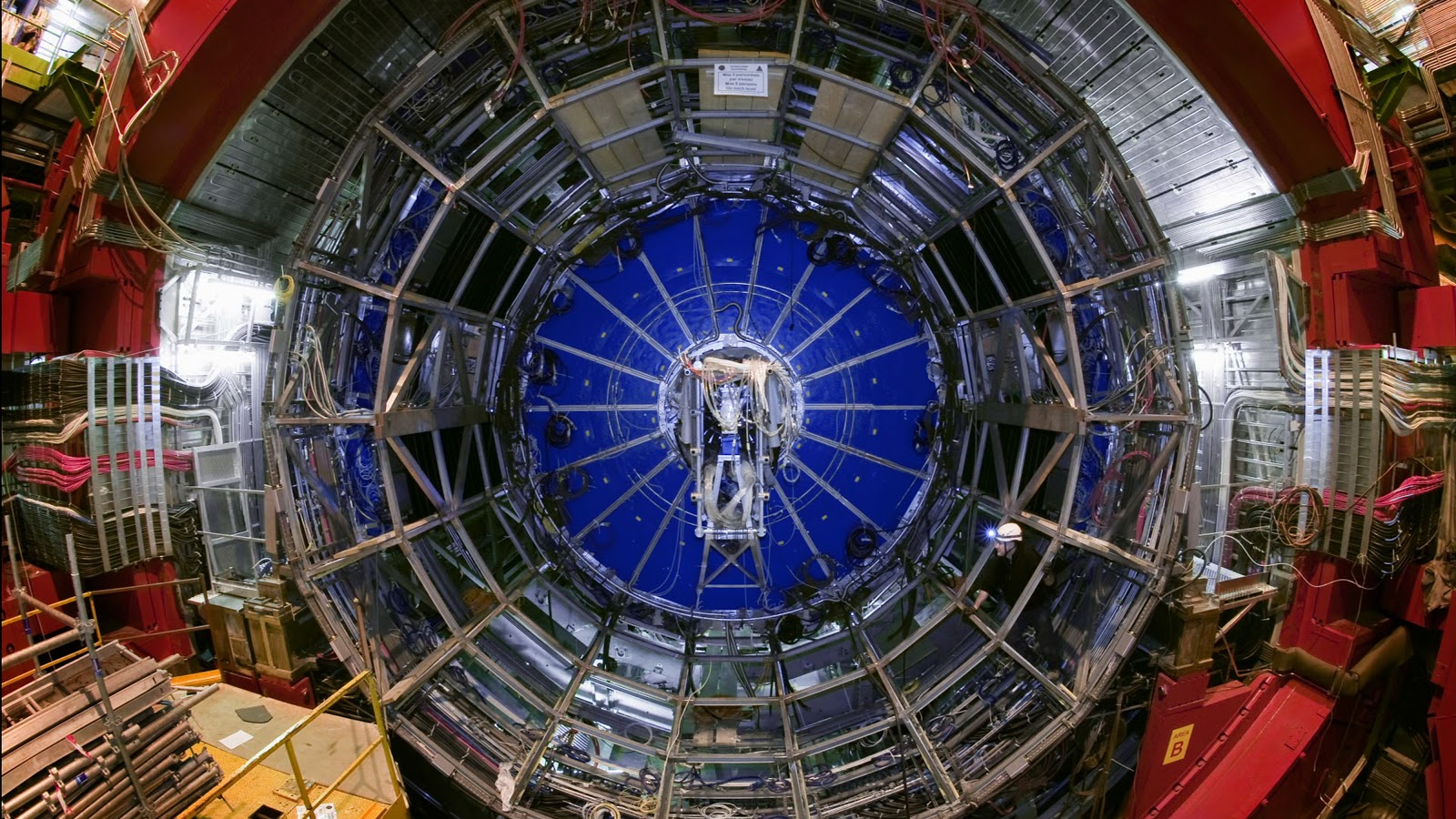
answers—or, as it turns out, deepening mysteries—The End of Time takes us to the European Organization of Nuclear
Research, or CERN, where physicists recreate the Big Bang in the massive Hadron
Collider particle accelerator; to Hawaii, where a man named Jack Thompson
knowingly lives within the annihilating lava path of an active volcano; to
Detroit, where the ravages of time can be read in nature’s reclaiming of the crumbling
vestiges of civilization; to India, where religious ritual promises escape from
time’s enslavement; to Mettler’s editing suite, where time is manipulated to
tell stories; to some liminal space made of hypnotic geometries and flickering
images generated by Mettler’s own image-mixing software. Film as journey: we
feel we’ve been taken far away, bedazzled, perplexed, enlightened, and safely
returned, all in under two hours.

The End of Time follows
the modus operandi of Mettler’s other extraordinary first-person travelogues: Eastern Avenue (1985), Picture of Light (1994), in which
Mettler goes to Churchill to film the Northern Lights, Balifilm (1997), Gambling,
Gods & LSD (2003), in which Mettler travels to Switzerland, the
American Southwest and India to meet people seeking transcendence through
diverse means, and Petropolis: Aerial
Perspectives on the Alberta Tar Sands (2009), in which Mettler gets in a
helicopter and surveys the draining of bitumen from the boreal forest, the
unwitting creation of a sinister kind of land art, and landscapes that feel like
homages to Antonioni’s Red Desert (1964),
at first spectrally beautiful, then horrifying when you realize this isn’t some
alien planet but our own province. Some have regarded The End of Time as a conclusion of this cycle, but I get the impression
that Mettler’s approach isn’t something devised for any particular project; it
is a way of moving, looking, listening, being, an activity that just happens to
result in some of the most important films this country has produced in the
last 30 years.
I spoke with Mettler
last year, when The End of Time was
premiering at the Toronto International Film Festival.

JB: When you’re in the act of shooting,
does time stop? Or do you feel more sensitive to time’s passage when the
camera’s running?
Peter Mettler: I think what happens when
I’m shooting is that time disappears. It’s one of the occasions where I feel most
present. You’re aware of being caught in time’s flow, which you’re always in, but
now you’ve added this layer of recording. You’re creating time, in a way,
creating a time experience for somebody. Ironically, that makes me feel
present. I’m certainly not thinking about time. It’s more about when to turn
the camera on and off and when to move it. It’s more about body reactions than
intellectual reactions.

JB: It seems there was a point in film
history when all movies became, in some sense, about time, capturing pieces of
time. They became self-conscious. So it’s as though you’ve taken this hidden subject
of all movies and dragged it to the foreground.
PM: I wasn’t aware of that so much. It was
only by making the film that this became apparent, how you point a camera at
anything and you’re addressing time itself. But I didn’t initially set out to
make a film about time; the original subject was clouds, what goes into them,
the vapours and where they come from, how they travel, how they return to the
ground or the ocean. My intention was to follow those cycles in a very literal
way. Petropolis came out of that,
because the tar sands is a particularly toxic place that was adding all this
junk into our clouds. By chance, Greenpeace contacted me to do something for
them and that project spun off into its own thing. Nonetheless, by studying
clouds I started thinking about time. If you recall, a physicist in the film
talks about how in some languages weather and time are the same word. So I
became more aware of transition, transformation, those occurrences which are
what we call time. Then it was a matter of questioning what this thing we call
time really is.

JB: There are mesmerizing passages in The End of Time in which you allow a lot
of time to simply pass before the camera, the part with the lava fields being
an especially memorable one. As you were figuring out what this project was,
was it ever going to be just that? Just lava, say? Just allowing time to speak
for itself before the camera?
PM: I could easily see myself just making a
film about lava. Not even about
lava—just watching lava. [Laughs] Lava for 90 minutes! We’ve done
this, just watched lava footage for that length of time in the editing room. It’s
intoxicating, really interesting where your mind goes. But here we are, living
in this particular time and use of media. So how do you present ideas? What’s
the format? We chose the feature film format and the documentary genre; you
can’t show a 90-minute lava film in that context. The rationale involves who
you’re communicating with, using familiar aspects of cinematic language while simultaneously
trying to lead the viewer to look at things a little differently. That lava
sequence is quite long for a traditional film. I think it’s about six minutes.

JB: Numerous elements in the film break
from documentary conventions. When you introduce commentators, for example,
there are no supers telling us who they are, and many of their comments are
abbreviated.
PM: One thing I’m trying not to do is to make a film that’s just
informational, you know? One that’s didactic or that uses words to illustrate
ideas. I’m much more interested in taking the viewer through an experience, to
form their own ideas and associations. Often when we see a label telling us
this is such a place or this is this person’s name. It rarely matters,
actually.
JB: That’s true. You almost never remember.
PM: I’m trying to make you feel and see and
wander and not be distracted by that stuff. I know this is a challenge, because
you want to know where you are. But I believe it’s better for my ends to be
provocative in that way.
JB: Is there any correlation between the
sequence of the film’s sections and the order in which you were discovering
these things, going to these places?
PM: Funny you should ask, because Gambling, Gods & LSD was
chronological. That was one of the rules in the edit of that film. I really
wanted to respect the logic and the mystery of how experience unfolds, how one
thing leads to another. With this film that was not the case. In fact a lot of
the film had already been edited by the time we were shooting in India. So it
was more constructed. But I think that logic of experience was still an
influence in how we were cutting.

JB: Movies so often feel very digested by
the time you see the final cut. It’s exciting to watch a film where you can
sense questions being asked in the midst of its making.
PM: Absolutely. I don’t know where I’m
going. Which is kind of terrifying in some respects, but you have to have faith
that things will find themselves. It happens that way in evolution, so why not
in a creative process?

JB: Having visited CERN and met with people
who do a lot of thinking about the physics of time, do you feel more
enlightened? Or did this research just compound the mystery?
PM: It was inspiring to see what they were
doing at CERN. I’d always imagined physics as more defined, but talking to
these people I got the impression that everything is very theoretical,
philosophical, in some ways similar to the pursuit I’m on with my cinema, with
observing. They call it “basic research” when they don’t know where they’re
going. I really became fond of that term. If you apply it to our cinematic
process of exploration, you know you’re going to end up with something, but you
don’t know what it is. That openness allows you to discover new things.

JB: Do you feel like making this film has
altered your sense of time’s passage?
PM: What it’s done is made me appreciate
transformation more deeply. Watching clouds or something else in nature, it’s
just made me more appreciate of being able to be with whatever is happening
right now, right here, in front of me. This moment.


